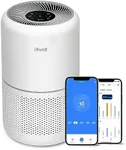
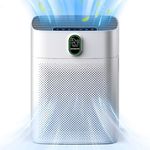
Buying Guide for the Best Quiet Air Purifier
Choosing a quiet air purifier is all about finding a balance between effective air cleaning and minimal noise. Air purifiers are great for improving indoor air quality by removing dust, allergens, and other particles, but if you want to use one in a bedroom, office, or nursery, quiet operation becomes especially important. To make the best choice, you should understand the main features that affect both performance and noise, and match them to your room size and sensitivity to sound.Noise Level (dB)Noise level, measured in decibels (dB), tells you how loud the air purifier will be when it's running. This is crucial if you want a device that won't disturb your sleep, work, or relaxation. Noise levels below 30 dB are considered very quiet, similar to a whisper, and are ideal for bedrooms or nurseries. Levels between 30-50 dB are moderate and suitable for living rooms or offices where some background noise is acceptable. Anything above 50 dB may be noticeable and could be distracting in quiet environments. To pick the right one, think about where you'll use the purifier and how sensitive you are to noise—if you need silence, aim for the lowest dB rating possible.
Room Coverage (Square Feet or M²)Room coverage tells you the maximum size of the area the air purifier can effectively clean. This is important because a purifier that's too small for your room won't clean the air efficiently, while one that's too large may be unnecessarily powerful (and sometimes noisier). Small purifiers cover up to 150 square feet and are best for bedrooms or small offices. Medium units handle 150-300 square feet, suitable for larger bedrooms or living rooms. Large purifiers can cover 300 square feet or more, ideal for open spaces or combined rooms. Measure your room and choose a purifier that matches or slightly exceeds your space for the best results.
Filter TypeThe filter type determines what kinds of particles the air purifier can remove. HEPA filters are the gold standard for capturing dust, pollen, and pet dander, and are essential for allergy sufferers. Some purifiers also include activated carbon filters, which help remove odors and gases. There are also washable or permanent filters, which can save on replacement costs but may not be as effective for fine particles. If you have allergies or want to remove odors, look for a purifier with both HEPA and carbon filters. If you just want basic dust removal, a standard filter may be enough.
Fan Speed SettingsFan speed settings let you control how fast the air purifier works and how much noise it makes. More speed options mean you can run the purifier quietly at night and more powerfully during the day. Some purifiers have just two or three speeds, while others offer more precise control or even an automatic mode that adjusts based on air quality. If you want flexibility, look for a model with multiple speeds or an auto mode, so you can keep things quiet when needed.
Sleep or Quiet ModeMany air purifiers have a special sleep or quiet mode that reduces noise by lowering the fan speed and dimming lights. This is especially useful for bedrooms or nurseries, where you want the air to stay clean without any disturbance. If you plan to use the purifier while sleeping or working, make sure it has this feature, as it can make a big difference in comfort.
Maintenance RequirementsMaintenance includes how often you need to replace or clean the filters and how easy it is to do so. Some purifiers have filter change indicators, which remind you when it's time for maintenance. If you want a hassle-free experience, look for models with easy-access filters and clear instructions. If you prefer less frequent maintenance, check the expected filter lifespan—some last several months, while others need more regular attention.