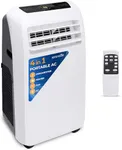
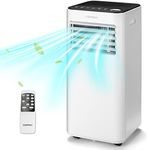
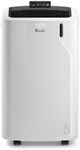
Buying Guide for the Best Portable Ac With Dehumidifier
Choosing a portable air conditioner with a dehumidifier function can make your living space much more comfortable, especially during hot and humid months. The right unit will not only cool your room but also remove excess moisture from the air, making it feel cooler and less sticky. To find the best fit for your needs, it's important to understand the main features and specifications that affect performance, convenience, and suitability for your space.Cooling Capacity (BTU)Cooling capacity, measured in BTUs (British Thermal Units), tells you how much heat the unit can remove from a room per hour. This is important because a unit that's too small won't cool your space effectively, while one that's too large may cool too quickly without properly dehumidifying. Small rooms (up to 200 sq ft) usually need 8,000-10,000 BTU, medium rooms (200-400 sq ft) need 10,000-14,000 BTU, and larger spaces may require more. To pick the right one, measure your room and match it to the recommended BTU range for efficient cooling and dehumidifying.
Dehumidification RateThe dehumidification rate tells you how much moisture the unit can remove from the air, usually measured in pints per day. This is important if you live in a humid area or want to reduce dampness in your space. Lower rates (30-40 pints/day) are fine for mild humidity or small rooms, while higher rates (50+ pints/day) are better for very humid climates or larger areas. Consider how damp your space gets and choose a unit with a dehumidification rate that matches your needs.
Room Size CompatibilityRoom size compatibility refers to the maximum area the unit can effectively cool and dehumidify. This is crucial because using a unit that's not suited for your room size can lead to poor performance. Manufacturers usually list the recommended room size in square feet. To choose the right one, measure your room and ensure the unit is rated for at least that size, or slightly larger if your space has high ceilings or lots of sunlight.
Portability FeaturesPortability features include things like caster wheels, handles, and compact design, which make it easier to move the unit from room to room. This is important if you plan to use the air conditioner in different spaces or need to store it when not in use. If you need to move it often, look for lightweight models with sturdy wheels and easy-grip handles. If it will stay in one place, portability may be less of a concern.
Noise LevelNoise level, usually measured in decibels (dB), tells you how loud the unit will be when running. This matters if you plan to use it in a bedroom, office, or any quiet space. Lower noise levels (under 50 dB) are best for sleeping or working, while higher levels may be acceptable in living rooms or kitchens. Think about where you'll use the unit most and choose a noise level that won't disturb your activities.
Drainage OptionsDrainage options refer to how the unit handles the water it collects while dehumidifying. Some units have a tank you need to empty, while others offer continuous drainage with a hose. If you don't want to empty a tank often, look for a model with a continuous drain option. If you only use the dehumidifier occasionally, a tank may be fine. Consider your convenience and how often you'll use the dehumidifier function.
Energy EfficiencyEnergy efficiency tells you how much electricity the unit uses to cool and dehumidify your space. This is important for keeping your energy bills lower and being environmentally friendly. Look for units with an Energy Efficiency Ratio (EER) or Energy Star certification. Higher EER numbers mean better efficiency. If you plan to use the unit frequently, choosing a more efficient model can save you money in the long run.
Control and Timer FeaturesControl and timer features include things like remote controls, digital displays, programmable timers, and smart connectivity. These features make it easier to operate the unit and customize its performance to your schedule. If you want convenience, look for models with remote controls or app compatibility. If you have a regular routine, a programmable timer can help you save energy by running the unit only when needed.