Buying Guide for the Best Compression Tester Kit
Choosing the right compression tester kit is important for anyone who wants to check the health of an engine, whether it's for a car, motorcycle, or small engine equipment. A good kit helps you measure the pressure in each cylinder, which can tell you a lot about the condition of the engine's internal parts. When picking a kit, you should focus on the compatibility with your engine, the accuracy of the gauge, the quality of the materials, and the ease of use. Understanding the key specifications will help you select a kit that matches your needs and ensures reliable results.Gauge AccuracyGauge accuracy refers to how close the readings on the compression tester are to the actual pressure inside the engine cylinder. This is important because inaccurate readings can lead to wrong conclusions about engine health. Gauges are usually rated by their accuracy, often as a percentage of the full scale. Basic kits may have a lower accuracy, which is fine for rough checks, while more precise kits are better for detailed diagnostics. If you need to make important decisions based on the readings, such as for professional repairs or engine rebuilding, choose a kit with higher accuracy. For occasional home use, a standard accuracy gauge is usually sufficient.
Pressure RangeThe pressure range tells you the minimum and maximum pressure the gauge can measure. This is important because different engines operate at different compression levels. For example, small engines may have lower compression, while high-performance or diesel engines have much higher compression. Kits with a range up to 300 PSI are common and suitable for most gasoline engines, while diesel engines may require a kit with a higher range. To pick the right one, check your engine's expected compression and make sure the kit covers that range comfortably.
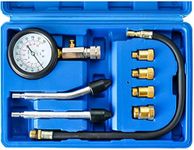
Adapter SelectionAdapter selection refers to the variety and sizes of fittings included in the kit, which allow the tester to connect to different spark plug or injector holes. This is important because engines come with different thread sizes and types. Kits with more adapters are more versatile and can be used on a wider range of engines. If you work on multiple types of engines or want flexibility, choose a kit with a broad selection of adapters. If you only need it for one specific engine, make sure the kit includes the correct adapter for your needs.
Hose Quality and LengthThe hose connects the gauge to the engine and needs to be both durable and long enough to reach comfortably. Hose quality is important because a weak or leaky hose can give false readings or break during use. Length matters for ease of use, especially in tight engine bays. Short hoses are fine for small engines or open spaces, while longer hoses are better for cars with hard-to-reach spark plugs. Choose a kit with a sturdy, flexible hose that suits the type of engines you plan to test.
Release ValveA release valve allows you to easily release the pressure from the gauge after a test. This is important for safety and convenience, as it lets you reset the gauge without disconnecting it from the engine. Some kits have a manual release button, while others may not have one at all. If you plan to do multiple tests in a row or want a smoother workflow, look for a kit with a reliable release valve.
Case and StorageA good case keeps all the parts of your compression tester kit organized and protected. This is important for both portability and longevity, as it prevents loss or damage to small adapters and the gauge. Kits with sturdy, well-designed cases are easier to store and transport, especially if you plan to use the kit in different locations. If you value organization and want your tools to last, choose a kit with a solid storage case.